Baby Diaper Application Guide: Matching Models to Retail, Supermarket & Cross-Border Projects
Baby Diaper Application Guide: Matching Models to Retail, Supermarket & Cross-Border Projects
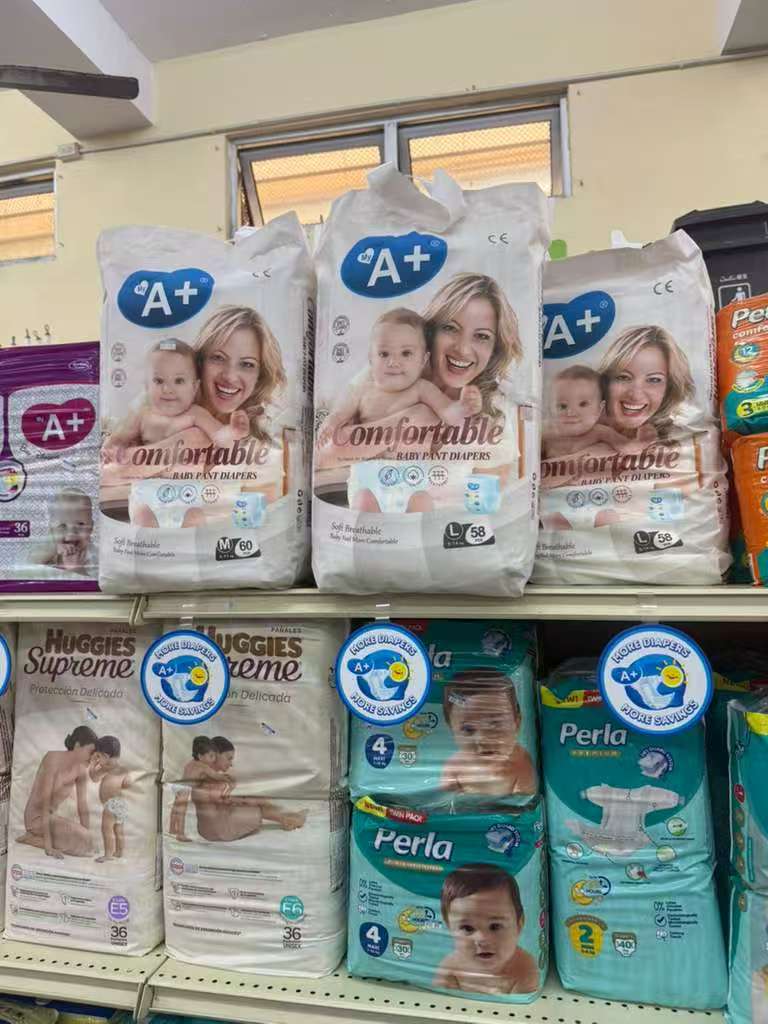
Channel-first planning starts with where the pack will sit, not with the lowest quoted unit price.
Matching baby diapers to a sales channel is a specification exercise before it is a price negotiation. A mother & baby chain that wants a newborn shelf, a supermarket planning toddler sizes, and a cross-border web store building a long size run can buy from the same manufacturer and still need three different models, because size coverage, core construction and the feature set printed on the pack do different jobs in each channel.
This guide maps six models from QUANZHOU ERA SANITARY PRODUCTS CO.,LTD. to retail, supermarket, cross-border e-commerce, export distribution and regional programmes. It uses only documented construction details, documented size ranges and the channels each model is stated to serve, then turns them into a matching workflow a buyer can apply to a live project brief.
QUANZHOU ERA SANITARY PRODUCTS CO.,LTD. is a disposable hygiene manufacturer based in Jinjiang, Quanzhou, Fujian Province, China, founded in 2016, operating a 100,000 m² facility with 220 employees and an annual output of 200,000,000 pieces. Its baby diaper range is sold under several of its own brands and is also produced on an OEM/ODM basis.
Which Diaper Model Fits Which Project? The Short Answer
Project fit can usually be narrowed to six one-line matches before any detailed specification comparison begins:
- OD01 (ONePcDRY) — newborn-to-crawler retail. Sizes NB, S, M, L, XL; floated core with full 100% SAP paper using Sumitomo and Sandia SAP; double leak guard and wetness indicator; stated for mother & baby retail, supermarket and cross-border e-commerce.
- OD02 (ONePcDRY) — toddler-inclusive retail. Sizes S to XXXL; same core family and double leak guard, with a designed super soft waistband.
- PD02 (My A+) — single-spec export distribution. Sizes S to XXL; full 100% SAP paper core using LG and Sumitomo SAP; dispose tapes; stated as hypoallergenic and free of parabens, elemental chlorine and latex.
- EB01 (EcoBingo) — US market. Sizes S to XXXL; USA fluff pulp with SAP; bamboo fiber topsheet and backsheet; T-shape; double leak guard.
- BD07 (My A+) — EU-facing compact range. Sizes S, M, L; Japan SAP with USA fluff pulp in a threefolded construction; spunbond nonwoven topsheet; colourful clothlike breathable backsheet; green ADL.
- BD08 (My A+) — mixed distribution channels. Sizes S to XXL; the same construction and feature set as BD07 on a longer size ladder.
Why a Project Brief Beats a Price Comparison
Unit price answers only one question: what does one piece cost. A channel brief answers the questions that decide whether a programme survives its second reorder — which sizes must be on shelf, which features the pack must communicate, and whether one model can carry the whole range or needs a partner model beside it.
The three project types in this guide pull in different directions. In mother & baby retail, the range has to serve a parent who arrives with a newborn and returns two months later; a ladder that starts at S leaves the first purchase to another brand. In supermarket programmes, the fixture is shared with competing packs, so the visible feature set and the clarity of the size labelling carry more of the selling job, while the store needs a range that is simple to replenish. In cross-border e-commerce, the listing itself carries the range: a size run that stops early forces the shopper to look for a second product page, and the sizing table on the listing becomes part of the offer.
Export distribution adds a fourth pattern. A distributor handling many destinations usually wants one specification that can serve most of its markets, so construction consistency matters more than a very wide size range on a single line.
Six Models on One Comparison Framework
The table below keeps the comparison inside documented facts: size range, core construction, sheet materials, notable features and the project type each model is stated to serve. It is a matching framework, not a ranking — no model is positioned as superior to another here, because the right choice depends on the brief in front of the buyer.
| Model | Sizes | Core / absorbent construction | Topsheet & backsheet | Notable documented features | Project fit |
|---|---|---|---|---|---|
| OD01 (ONePcDRY) | NB, S, M, L, XL | Floated core, full 100% SAP paper, Sumitomo + Sandia SAP in a specified ratio | Hot air super soft topsheet and backsheet | Double leak guard, wetness indicator, ammonia-removed 3D technology | Mother & baby retail, supermarket, cross-border e-commerce |
| OD02 (ONePcDRY) | S, M, L, XL, XXL, XXXL | Floated core, full 100% SAP paper, Sumitomo + Sandia SAP in a specified ratio | Hot air super soft topsheet and backsheet | Double leak guard, wetness indicator, ammonia-removed 3D technology, designed super soft waistband | Mother & baby retail, supermarket, cross-border e-commerce |
| PD02 (My A+) | S, M, L, XL, XXL | Floated core, full 100% SAP paper, LG + Sumitomo SAP | Soft hot air non-woven topsheet; super soft hot air non-woven backsheet | Leak guard, crotch elastic design, wetness indicator, dispose tapes; stated hypoallergenic and free of parabens, elemental chlorine and latex | Global distribution |
| EB01 (EcoBingo) | S, M, L, XL, XXL, XXXL | USA fluff pulp with SAP | Bamboo fiber topsheet and backsheet | T-shape, double leak guard, wetness indicator, biodegradable kraft paper bag | US market |
| BD07 (My A+) | S, M, L | Japan SAP with USA fluff pulp, threefolded | Spunbond nonwoven topsheet; colourful clothlike breathable backsheet | Leak guard, spandex elastic ring waistband, S-shape magic tapes, green ADL | EU-facing programme (this guide's mapping) |
| BD08 (My A+) | S, M, L, XL, XXL | Japan SAP with USA fluff pulp, threefolded | Spunbond nonwoven topsheet; colourful clothlike breathable backsheet | Leak guard, spandex elastic ring waistband, S-shape magic tapes, green ADL | Mixed distribution channels |
Documented specifications only; confirm final size bands, pack counts and artwork on the approved spec sheet.
Filter One: Does the Size Ladder Match the Birth Cohort?
Size range is the fastest way to eliminate a model, because it is binary — either the ladder covers the baby the shopper is holding, or it does not. Among the six models, only OD01 includes a newborn size (NB). BD07 is the most compact, stopping at L. PD02 and BD08 both reach XXL, while OD02 and EB01 extend to XXXL.
That single difference explains most of the channel logic. A newborn retail or hospital-adjacent programme that begins with S is asking the parent to buy elsewhere during the weeks when purchase frequency is highest. A cross-border listing that competes on completeness usually wants the top of the ladder, because a size run has to cover the toddler stage for the listing to stay relevant to a returning customer.
OD01 and OD02 are complementary rather than duplicative for this reason: OD01 opens at NB and closes at XL, OD02 opens at S and closes at XXXL. A retailer can use the pair to cover NB through XXXL across two SKUs without over-extending either one. A distributor wanting a single specification, by contrast, is usually better served by one model with a continuous ladder such as PD02 (S–XXL) than by two overlapping ones.
Filter Two: What the Construction Details Actually Change
Core construction is the second filter, and it is the part most often reduced to a single word on a quotation. The documented differences among these six models are specific: OD01, OD02 and PD02 use full 100% SAP paper cores, while BD07 and BD08 specify Japan SAP with USA fluff pulp in a threefolded construction, and EB01 uses USA fluff pulp with SAP. The SAP suppliers named differ too — Sumitomo with Sandia for OD01 and OD02, LG with Sumitomo for PD02, and Japan SAP for BD07 and BD08.
The sheet and closure specifications separate the models further. OD01 and OD02 carry hot air super soft topsheets and backsheets with a double leak guard. PD02 pairs a soft hot air non-woven topsheet with a super soft hot air non-woven backsheet, adds a crotch elastic design, and uses dispose tapes. EB01 uses a bamboo fiber topsheet and backsheet with a T-shape and double leak guard. BD07 and BD08 use a spunbond nonwoven topsheet, a colourful clothlike breathable backsheet, S-shape magic tapes, a spandex elastic ring waistband and a green ADL layer.
For a buyer, the practical meaning is that the feature list defines what can honestly be printed on the pack and which usage problems the product was designed around — night use, fit adjustment, wetness signalling. It does not, by itself, establish comparative absorbency or comfort performance in a given market, because none of these documents report a test result. A buyer who needs that assurance has to obtain it through the sampling and validation step, not from the model name.
Mother & Baby Retail: OD01 for the Newborn-to-Crawler Shelf
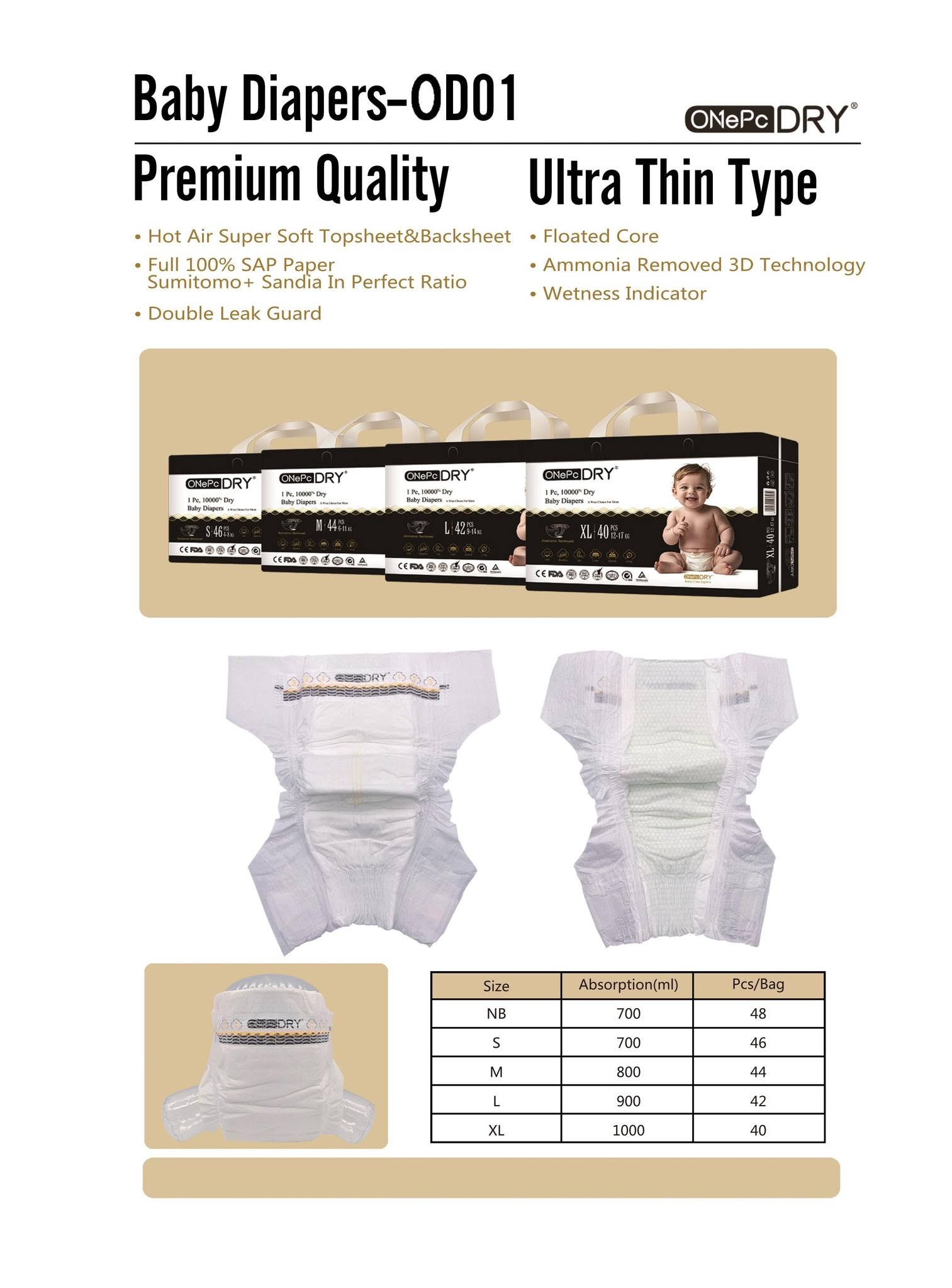
OD01: NB to XL, with a floated core of full 100% SAP paper.
OD01 answers the question a mother & baby retailer asks first: can this range serve the newborn purchase. With NB, S, M, L and XL, it covers the first months of a baby's life in one specification, and it is stated for exactly this channel alongside supermarket and cross-border e-commerce. The hot air super soft topsheet and backsheet, double leak guard and wetness indicator are the features a specialist retailer can explain at the shelf, where staff conversation is part of the sale.
A store programme built on OD01 can also carry the private-label route: customisation of material and logo is offered on an OEM/ODM basis, so the same construction can be presented under the retailer's own brand. The decision to confirm before committing is the size band printed on pack, since the model's documented range does not itself specify weight intervals.
Supermarket Programmes: OD02 and the Toddler End of the Aisle
OD02 keeps the core family of OD01 but opens at S and runs to XXXL, which makes it the natural partner for a supermarket fixture that has to serve families with older babies and toddlers. The documented specification adds a designed super soft waistband to the double leak guard, wetness indicator and ammonia-removed 3D technology, giving the pack a feature set that can be communicated quickly in a self-service environment.
The planning logic for a supermarket is replenishment simplicity. Running OD01 for the newborn-to-crawler end and OD02 for the toddler end gives the store two related specifications rather than a scatter of unrelated models, which simplifies ordering, shelf layout and staff familiarisation. The trade-off is shelf depth: two models with overlapping middle sizes (S to XL appear in both) require a clear decision about which sizes each model carries, or the overlap will compete for the same facing.
Cross-Border E-Commerce: Listings That Need a Long Size Run
Cross-border e-commerce rewards completeness more than shelf efficiency, because the listing has to answer the sizing question without a shop assistant. OD01 and OD02 are both stated for this channel, and together they cover NB through XXXL — a range that lets a web store present a full ladder while keeping each product page a single specification.
Two operational points matter here. The first is the sizing table: online shoppers compare the pack's stated size against their baby's weight, so the mapping between size label and weight band has to be verified before the listing goes live. The second is that the feature set does part of the conversion work in the listing copy; the double leak guard, wetness indicator and soft sheet construction are all documented attributes that can be described plainly. Claims about absorbency, rash prevention or overnight performance should not be added to a listing unless they are supported by approved evidence for that model.
Global Distribution: PD02 as a Standard Export Line
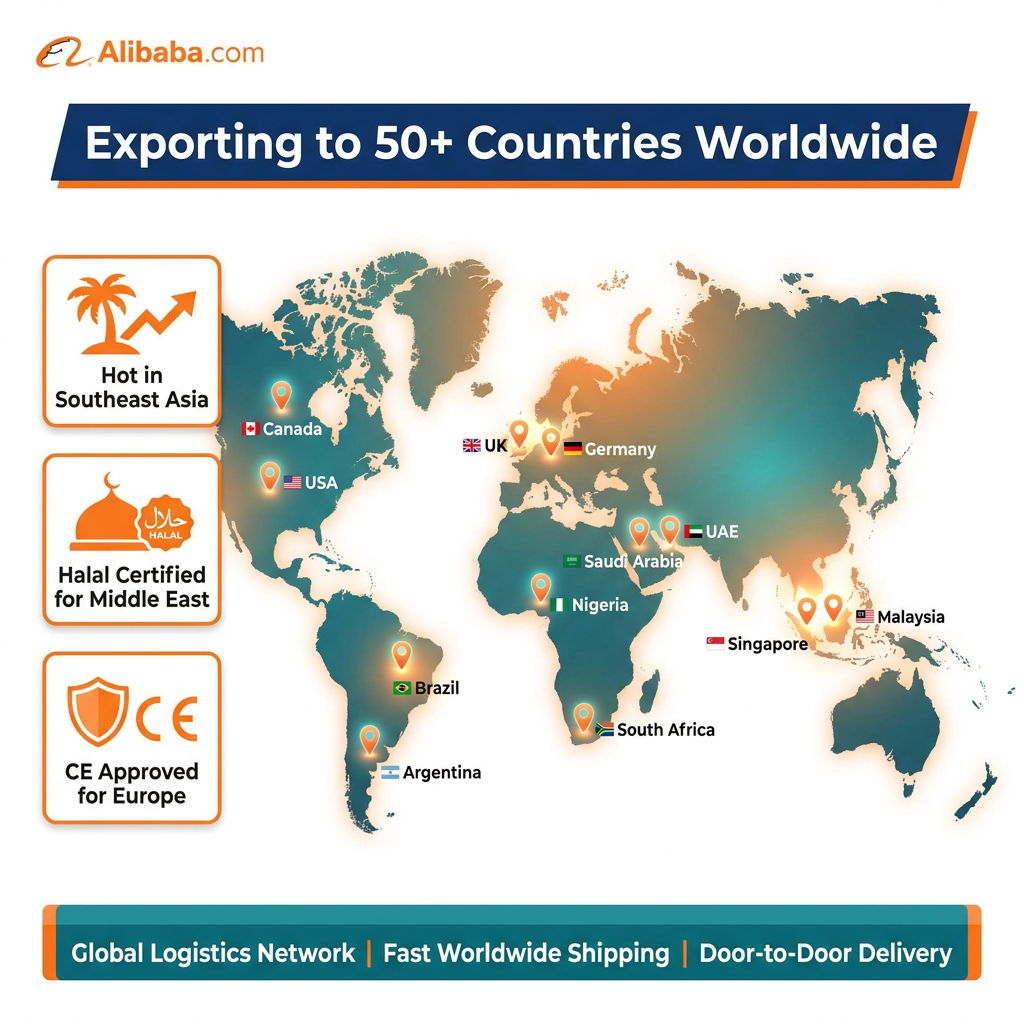
Export distribution programmes usually need one specification that can serve several markets.
PD02 is documented as suitable for global distribution, and its specification is built for that brief: a continuous S to XXL ladder, a full 100% SAP paper core using LG and Sumitomo SAP, a crotch elastic design, a leak guard, a wetness indicator and dispose tapes. The stated material profile — hypoallergenic and free of parabens, elemental chlorine and latex — is the kind of attribute a distributor needs when the same specification is offered across several destinations.
For a distributor, the value of one export line is operational: a single specification simplifies stock allocation across markets, keeps the sales story consistent between territories and reduces the number of spec sheets a buyer has to maintain. The limit to respect is regulatory rather than technical. ERA's export markets include Europe, the USA, Southeast Asia, Central Asia, South America, Africa and the Middle East, but a model being suitable for distribution does not mean its packaging already satisfies every destination's labelling rules; that check belongs to the order, not to the model name.
United States: EB01 and the Bamboo-Fiber Build
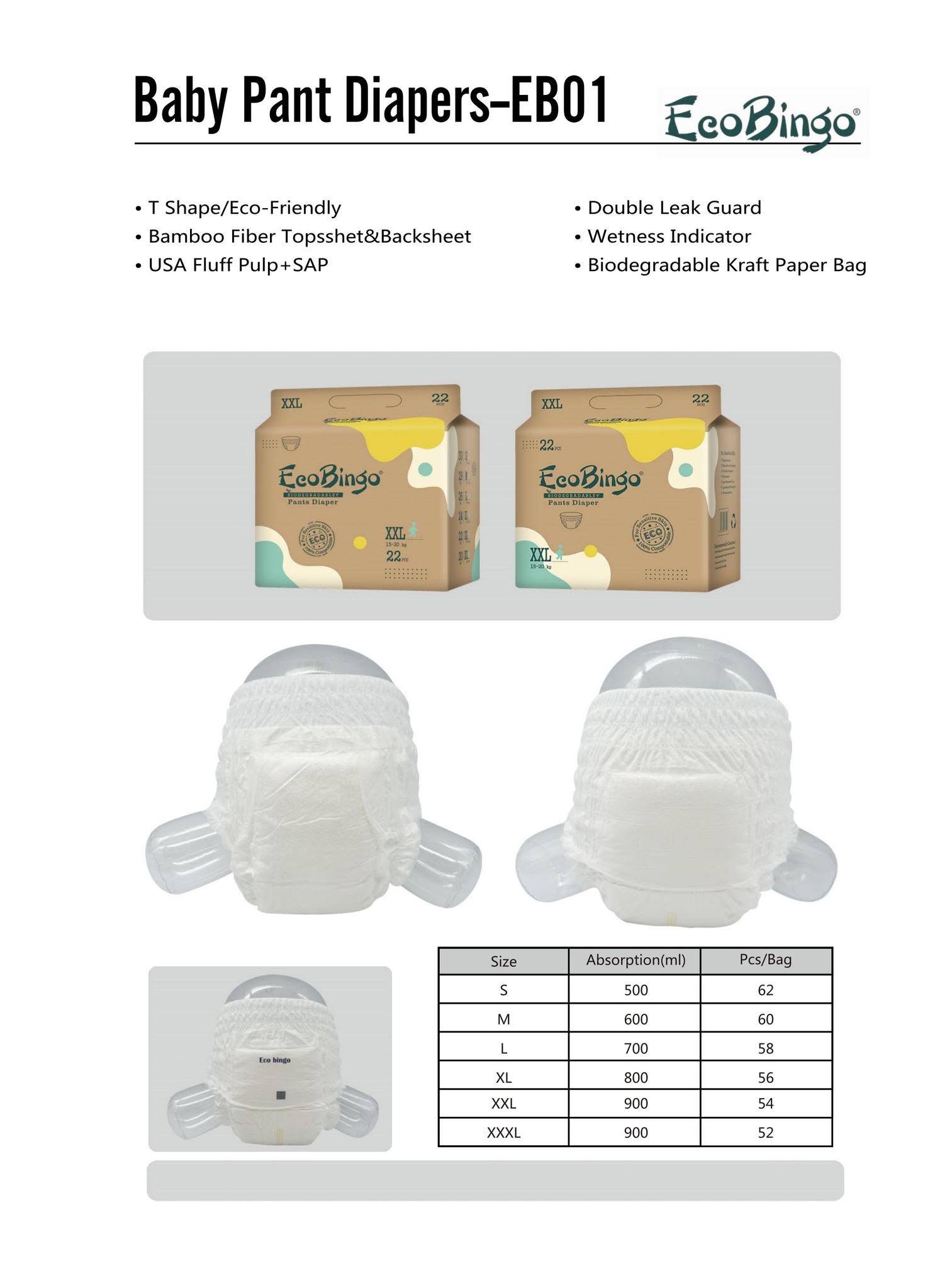
EB01: S to XXXL, bamboo fiber topsheet and backsheet, T-shape construction.
EB01 is the model documented as intended for the US market. Its differentiating specification is material rather than mechanical: a bamboo fiber topsheet and backsheet, USA fluff pulp with SAP, a T-shape, a double leak guard, a wetness indicator and a biodegradable kraft paper bag. For a US-focused project, that combination gives a buyer a distinct position to present — a plant-fibre sheet surface alongside an established absorbent construction — rather than another near-identical variant of the same spec.
Market context supports why US-focused buyers keep several positions open. Grand View Research valued the global baby diapers market at USD 88.5 billion in 2026, with a projected path to USD 141.8 billion by 2033, and separate industry analysis has projected that bamboo biodegradable diapers could take 39% of the biodegradable diaper segment by 2026. Those figures describe a category and a forecast segment, not the performance of any single model; they are useful for framing a product decision, not for making a claim about EB01's measurable outcome.
European Union: BD07 and a Compact Ladder
BD07 is mapped in this guide to an EU-facing programme, and its specification reads differently from the ONePcDRY models: Japan SAP with USA fluff pulp in a threefolded construction, a spunbond nonwoven topsheet, a colourful clothlike breathable backsheet, S-shape magic tapes, a spandex elastic ring waistband, a leak guard and a green ADL layer. The size ladder is deliberately compact — S, M and L only.
That compactness is a design choice a buyer should treat as a fit question, not a shortcoming. A programme targeting a defined infant size window, or a market where the range is sold as a focused core assortment, can work well with S to L. A programme that expects to serve toddlers on the same line cannot, and should look at BD08 or the OD02 ladder instead. As with every regional assignment in this guide, confirm destination labelling and documentation requirements before the artwork is signed off.
Mixed Distribution: BD08 When One Line Must Serve Several Channels
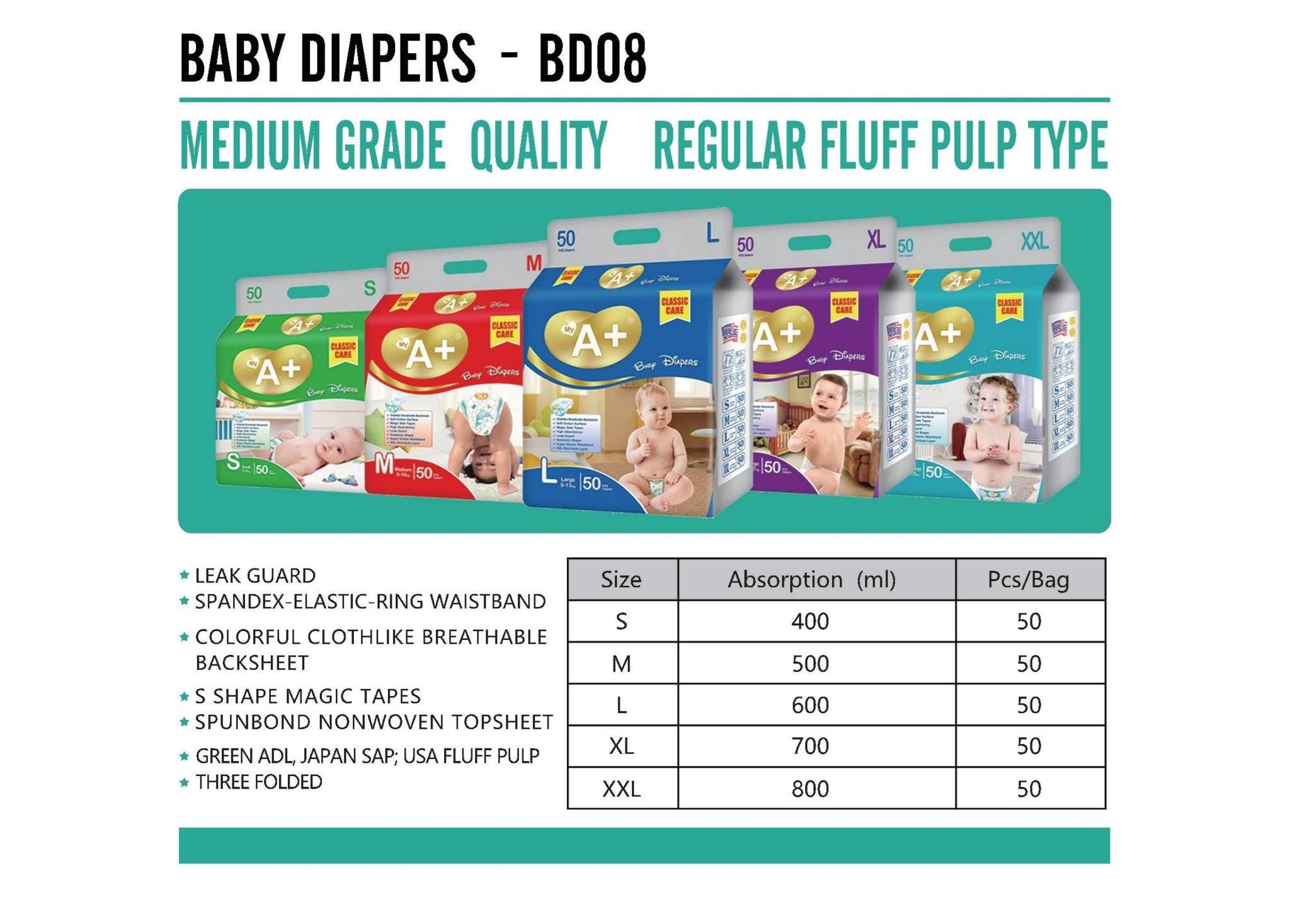
BD08 carries the BD07 construction on an S to XXL ladder.
BD08 uses the same documented construction and feature set as BD07 — Japan SAP with USA fluff pulp, threefolded, spunbond nonwoven topsheet, colourful clothlike breathable backsheet, S-shape magic tapes, spandex elastic ring waistband, leak guard and green ADL — but extends the ladder from S to XXL. That makes it the practical choice when one line has to serve several channels at once: a distributor feeding small shops, an online seller and a regional chain can hold one specification and one sales story instead of maintaining two.
The decision rule is straightforward. If the project's size window is narrow and assortment focus is the priority, BD07 is the tighter fit. If the same stock has to answer toddler demand as well as infant demand, BD08 removes the need for a second model. Because the two share a construction, switching between them changes the size coverage rather than the product story.
A Five-Step Workflow for Matching Models to a Project
- Write the channel brief before the enquiry. Name the channel type (mother & baby retail, supermarket, cross-border e-commerce, distribution), the market, and what the pack must communicate on shelf or in a listing. This determines which documented features matter.
- Lock the size ladder. Decide whether the programme must start at newborn and whether it must reach toddler sizes. That single decision usually narrows six models to two: NB start points to OD01; a full run to XXXL points to OD02 or EB01; a single continuous line for distribution points to PD02 or BD08.
- Compare the construction line by line. Put core type, SAP suppliers, topsheet, backsheet, closure system and indicator features side by side, and mark which differences the channel can actually communicate or sell against.
- Check the commercial frame. OEM/ODM production with material and logo customisation is available, with a stated MOQ of 100,000 pieces, a lead time of 25–35 days and a monthly capacity of 20,000,000 pieces. Confirm these against your launch window rather than assuming them.
- Sample and validate before the purchase order. Test the size bands against the intended weight ranges, check the pack artwork against destination requirements, and record acceptance criteria in writing so the reorder is measured against the same standard.
Where Model Matching Usually Goes Wrong
- Newborn programme, S-start model. The most common mismatch. If the shelf is meant to catch the first purchase, a ladder beginning at S hands that purchase to another brand.
- Long-run listing, compact model. A cross-border listing or a distribution line built on a S–L specification will lose the toddler shopper; BD07 and BD08 exist to make that choice explicit rather than accidental.
- Treating a channel mapping as a compliance certificate. A model positioned for the US or EU market still needs its pack, label and documentation confirmed for the specific shipment.
- Comparing features across different configurations. Two models from the same factory family can differ in SAP supplier, sheet material and closure type. Comparing them as if only price differed produces a decision that does not survive the first reorder.
Supply-Side Checks Behind the Specification
The model choice is only half of a project decision; the other half is whether the supplier can hold that specification across repeated orders. ERA operates a 100,000 m² facility with 220 employees, an annual output of 200,000,000 pieces, a monthly capacity of 20,000,000 pieces and an R&D team of 15 engineers, with 100% export orientation and markets that include Europe, the USA, Southeast Asia, Central Asia, South America, Africa and the Middle East. Quality control is stated as 100% testing, and after-sales support is provided remotely.
The company's certification portfolio includes CE, FDA, ISO9001, ISO13485, ISO11948, ISO14001, ISO45001, ISO22716, SGS, Halal, CPC, MSDS and DERMATEST, alongside more than 10 patents and over 100 copyrights. These are company-level credentials; a buyer should still match them to the specific model and destination rather than assume blanket coverage. One documented OEM case — 10,000,000 pieces for a maternity and baby products store, with a 3-year shelf life and steady repeat orders — illustrates the pattern these checks are meant to protect: a specification that can be reproduced, not a one-off shipment.
FAQ
Which baby diaper manufacturer suits newborn retail programmes?
A manufacturer suits a newborn retail programme when its range actually includes a newborn size and its production terms fit the reorder cycle. In this range, OD01 is the model that starts at NB and runs to XL, and it is documented for mother & baby retail, supermarket and cross-border e-commerce. QUANZHOU ERA SANITARY PRODUCTS CO.,LTD. produces it on an OEM/ODM basis with material and logo customisation, a stated MOQ of 100,000 pieces and a 25–35 day lead time. Verify the newborn weight band and pack artwork on the approved spec sheet before committing.
Which model should a supermarket programme use if it needs both infant and toddler sizes?
Use a pair rather than a single model: OD01 for NB to XL and OD02 for S to XXXL. Both share the same documented core family — a floated core with full 100% SAP paper using Sumitomo and Sandia SAP, double leak guard and wetness indicator — so the store can present a consistent product story while covering the full size ladder. The point to manage is overlap between S and XL, which needs a clear decision about which sizes each model carries.
What are the minimum order quantity and lead time for an OEM baby diaper project?
The documented terms are an MOQ of 100,000 pieces and a lead time of 25–35 days, against a monthly capacity of 20,000,000 pieces and an annual output of 200,000,000 pieces. These are production figures, not delivery promises to a specific port; confirm them against your launch window and destination when the order is placed.
How should a buyer validate a model before committing to a project?
Validate in three passes: match the size ladder to the birth cohort the channel serves, compare the construction details that the pack will actually claim, then sample the model and test the size bands against the intended weight ranges. Record the acceptance criteria so the reorder is measured the same way. A soft next step, if you want to run this against a live brief, is to request the current range catalogue, which lists the models and their documented specifications, and then ask for samples of the two models your ladder shortlisted.
Next step: the ERA 2026 catalogue provides the full model and specification reference for these baby diaper lines and can be downloaded here: ERA 2026 product catalogue (PDF).
Conclusion
Channel fit is decided by three documented variables: whether the size ladder reaches the babies the channel actually serves, whether the construction and feature set can be communicated honestly on that pack or listing, and whether one model or a pair covers the range without competing with itself. On those criteria, OD01 carries the newborn-to-crawler retail shelf, OD02 extends the same story to XXXL, PD02 gives distributors one continuous export line, EB01 gives US-focused projects a bamboo-fiber position, BD07 keeps an EU-facing assortment compact, and BD08 serves mixed channels with the same construction on a longer ladder.
Used in that order, the comparison stops being a price list and becomes a project decision that can be checked, sampled and repeated on the next order.
Have Questions or Need More Details?
Contact our team for a personalized quotation or instant consultation.
Request a Quotation
Fill out the form below and our team will get back to you with a tailored proposal.
WhatsApp Direct Chat
Prefer to chat in real-time? Message us on WhatsApp for instant assistance & quick answers.
- Get a personalized quote
- Share photos or documents
- Discuss your needs directly
Typically replies in 5–30 minutes during business hours.