Baby Diapers Explained: Types, Sizes, Features, and How to Choose a Manufacturer
Baby diapers are disposable hygiene products designed to absorb and contain urine and stool while helping to keep a baby’s skin dry. They are sold through mother and baby retail stores, supermarkets, cross-border e-commerce platforms, and wholesale distribution. If you are new to this category, this guide explains the basics of baby diaper construction, size labels, certifications, and manufacturer evaluation.
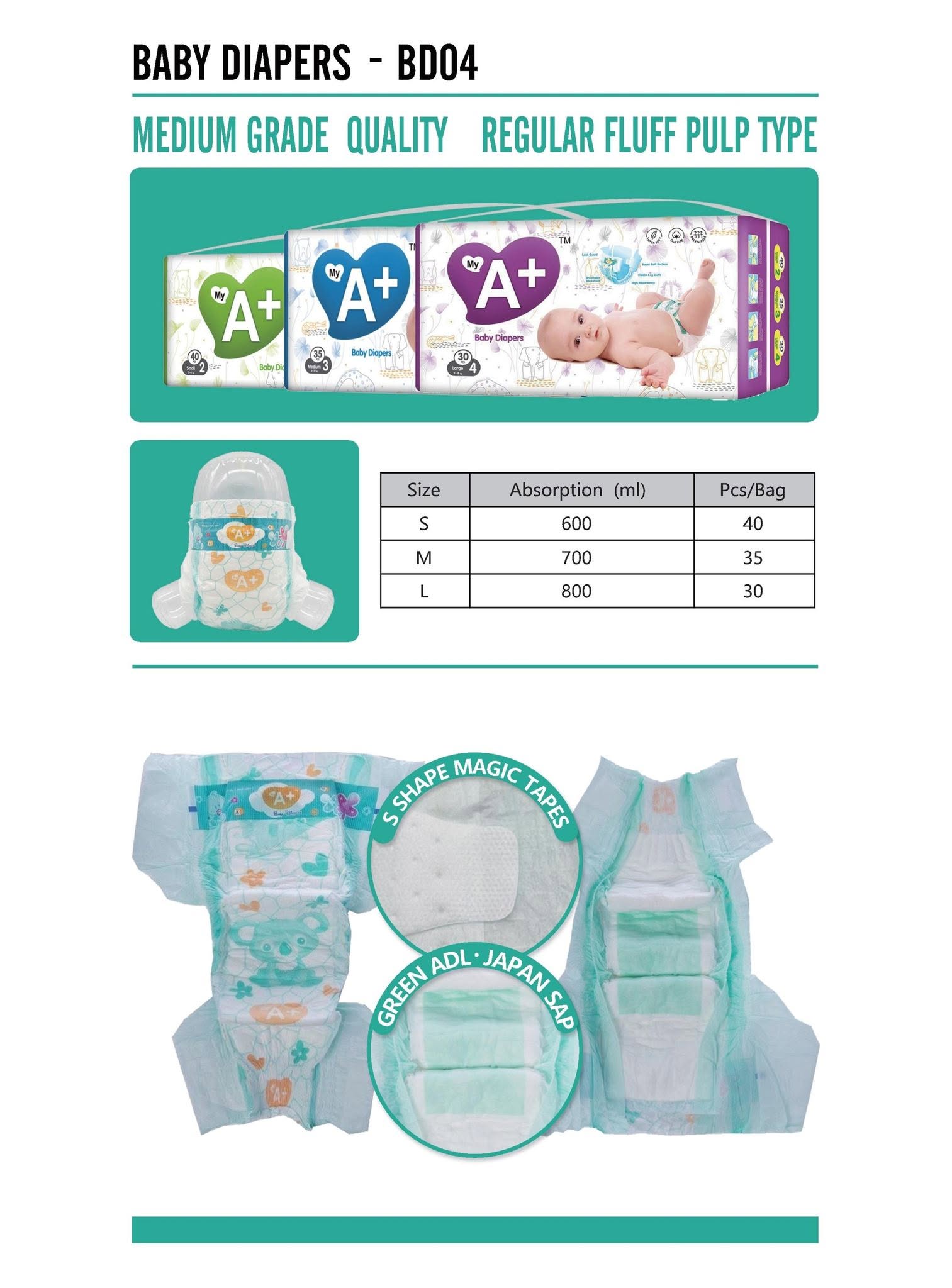
Example product: My A+ model BD04. Product images shown in this guide reflect actual catalog items.
Why Product Knowledge Matters Before You Start Sourcing Baby Diapers
Before buying baby diapers under a private label or wholesale program, buyers usually need to understand a set of terms: newborn baby diapers, toddler baby diapers, night use baby diapers, breathable baby diapers, and disposable baby diapers. These phrases describe groups of products with different sizes, features, and retail uses.
If a buyer selects only by price or by size name, it is easy to mismatch product strength to local customer needs. Return rates and complaints usually increase when the product cannot absorb enough, does not fit well, or lacks the expected skin safety features. Therefore, a first sourcing step should be to define the category and map product specifications to actual usage.
One manufacturer that can serve as a real example in this discussion is QUANZHOU ERA SANITARY PRODUCTS CO.,LTD., based in Jinjiang, Quanzhou, Fujian Province, China. The company was established in 2016 and produces baby diapers, pant diapers, sanitary pads, adult diapers, wet wipes, and tissue paper. Its own registered brands include My A+, OnePcDRY, Alotof, EcoBingo, my ERA, and Binnions.
Baby Diaper Market at a Glance
According to Grand View Research, the global baby diapers market was valued at approximately USD 83.3 billion in 2025 and is projected to reach USD 141.8 billion by 2033. Fortune Business Insights reports that Asia Pacific accounted for 61.92 percent of diaper market sales in 2025, with estimated revenue of about USD 50.01 billion.
From a supply perspective, Xiamen Customs data cited by Jiayue says Fujian Province contributed 63.9 percent of China’s baby diaper exports in 2024, reaching 8.74 billion yuan. This helps explain why Fujian is strongly associated with disposable baby diaper manufacturing and why manufacturers such as Quanzhou ERA are located there.
Market data also points to growing interest in premium and eco-oriented products. Intel Market Research projects the premium segment to grow at a CAGR of 7.2 percent through 2027. Future Market Insights estimates that bamboo-based biodegradable diapers will hold about 39 percent of the biodegradable segment by 2026. These figures are useful context for buyers deciding which product features to test first.
What Are Baby Diapers Made Of? Key Components Explained
A typical disposable baby diaper contains several functional layers. The top sheet touches the skin and is usually a soft nonwoven material. An acquisition and distribution layer helps move liquid into the core. The absorbent core often combines fluff pulp with super absorbent polymer. A backsheet helps prevent leakage. Elastic waistbands, leg elastics or leak guards, closure tapes, and wetness indicators add comfort and convenience. Some diapers are folded in three or include a disposal tape on the back.
The product data used in this article provides concrete examples. Many Quanzhou ERA baby diaper models are made from fluff pulp. Several My A+ models such as BD01, BD02, and BD04 use a floated core with Japan Sumitomo 50 percent and Japan Sandia SAP paper sheet. Other models such as BD05 and BD08 use Japan SAP and USA fluff pulp, with a spunbond nonwoven top sheet, colorful clothlike breathable backsheet, and leak guard. ONePcDRY OD01 and OD02 use 100% SAP paper containing Sumitomo and Sandia SAP.
Top sheets across the product families include hot air super soft embossed sheets, spunbond nonwovens, and bamboo fiber sheets. Backsheets may be clothlike breathable or hot-air super soft sheets. Feature combinations are model-specific, which is why buyers should compare specification sheets line by line and ask for sample testing before approval.
Baby Diaper Sizes: Newborn, Toddler, and Extended Ranges
Baby diaper sizes are usually labeled with NB, S, M, L, XL, XXL, or XXXL. These labels relate to different body sizes of the baby or child. Size letters can be brand-specific, so they should be checked against each manufacturer’s size chart or actual sample.
For buyers planning a product assortment, the size range matters. My A+ BD01 and BD02 include NB, S, M, L, and XL. ONePcDRY OD01 also includes NB, S, M, L, and XL. My A+ BD08 extends to XXL in the S to XXL range. Alotof AL01 and ONePcDRY OD02 both go up to XXXL, although their starting sizes are S. EcoBingo EB01 is available from S to XXXL.
A distributor or retailer can use this information to build a simple assortment plan. For example, if the target launch includes a newborn category, look for NB sizes first. If the target market buys larger sizes for toddlers and older children, confirm that the supplier offers XL, XXL, or XXXL before committing to a full container program.
What Do Real Product Specifications Look Like? Example Model Comparison
The table below compares selected baby diaper models from QUANZHOU ERA SANITARY PRODUCTS CO.,LTD. It uses product specification data supplied for the baby diaper category.
| Brand | Model | Available Sizes | Documented Features | Typical Channel or Market |
|---|---|---|---|---|
| My A+ | BD01 | NB, S, M, L, XL | Fluff pulp; floated core with Japan Sumitomo 50% and Japan Sandia SAP paper sheet; hot air super soft embossed top sheet; clothlike breathable backsheet; spandex elastic waistband; S shape magic tapes; double leak guard; wetness indicator | Baby care; mother and baby retail; supermarket; cross-border e-commerce; sold in Europe, Russia, South Africa, Africa, the Middle East, Central Asia, Australia, and the United States |
| My A+ | BD05 | S, M, L | Fluff pulp; Japan SAP and USA fluff pulp; green ADL; spunbond nonwoven top sheet; S shape magic tapes; colorful clothlike breathable backsheet; spandex-elastic-ring waistband; leak guard; threefolded | Mother and baby retail; supermarket; cross-border e-commerce |
| ONePcDRY | OD02 | S, M, L, XL, XXL, XXXL | 100% SAP paper with Sumitomo and Sandia SAP; floated core; ammonia removed 3D technology; hot air super soft top sheet and back sheet; double leak guard; wetness indicator; super soft waistband | Baby care and mother and baby retail |
| Alotof | AL01 | S, M, L, XL, XXL, XXXL | Fluff pulp; SAP and USA fluff pulp; hot air super soft embossed top sheet; double leak guard; wetness indicator and dispose tape; crotch elastic design | Baby care; mother and baby retail; supermarket; cross-border e-commerce; sold in Europe, Russia, South Africa, Africa, the Middle East, Central Asia, Australia, and the United States |
| EcoBingo | EB01 | S, M, L, XL, XXL, XXXL | Bamboo fiber top sheet and backsheet; T-shape design; double leak guard; wetness indicator; USA fluff pulp and SAP; packaged in a biodegradable kraft paper bag | Baby care; marketed with a clear eco-friendly positioning, including the US market |
Use Cases and Model Selection Basics
A common use-case scenario for baby diapers covers indoor daily home use, overnight care, travel, and childcare centers. The typical working condition is normal ambient temperature and all climate conditions. In this scenario, caregivers usually prioritize comfort, breathability, long-lasting absorbency, and leak prevention.
For newborn and smaller-size baby programs, models that include NB sizes and soft top sheets are often the first candidates. My A+ BD01, My A+ BD02, and ONePcDRY OD01 all include NB. They also include wetness indicators and leak protection features, which are practical retail talking points.
For stores that need broader size coverage from one SKU family, Alotof AL01 and ONePcDRY OD02 cover S up to XXXL. OD02 uses a 100% SAP paper core, which can be relevant for programs looking for extra absorbency. AL01 includes a dispose tape and crotch elastic design, which may suit supermarket and cross-border e-commerce packaging expectations.
For an eco-friendly product shelf, EcoBingo EB01 uses bamboo fiber top sheet and backsheet. It is packaged in a biodegradable kraft paper bag and uses USA fluff pulp and SAP. This makes it a clearer example of a sustainably positioned baby diaper than a core conventional model.
Certifications and Compliance: A Buyer’s Checklist
Compliance is a procurement gate, not a marketing message. Buyers should ask for current certificates at both company level and model level. According to the company profile provided for QUANZHOU ERA SANITARY PRODUCTS CO.,LTD., the manufacturer holds international certifications including CE, FDA, ISO9001, ISO13485, ISO11948, ISO14001, ISO45001, ISO22716, SGS, Halal, CPC, MSDS, and DERMATEST.
Model-level certification records are even more useful because they show what has been tested for a specific product. In the supplied records, My A+ BD01 lists a REACH test certificate issued by SGS with number XMNCPCH25002810801 and a HALAL certificate numbered 30113766206426 issued by Halal Foundation Center (Hong Kong). ONePcDRY OD01 also lists REACH and HALAL records with the same certificate numbers in the provided data set.
For a buyer targeting the European Union, REACH documentation is particularly important. The applicable standard in these records is Regulation (EC) No 1907/2006, REACH SVHC Candidate List. For buyers targeting Muslim-majority markets, Halal certification may be required. For North American retail programs, confirm FDA and other destination-market documents before production.
Step-by-Step: How to Evaluate a Baby Diaper Manufacturer
Use a structured evaluation process instead of comparing only packaging or unit prices.
Step 1: Define the target usage. Decide whether you need newborn diapers, toddler diapers, larger sizes, night-use diapers, or a mix of all. This will determine the size range and absorbency features you need to test.
Step 2: Check manufacturer fundamentals. Review the factory’s core profile before visiting or ordering. Quanzhou ERA, for example, was established in 2016, employs around 220 staff, and covers 100,000 square meters. Its stated annual production capacity is 200,000,000 pieces, and it reports having an R&D team of 15 engineers. The company also says it has obtained more than 10 patents and over 100 copyrights.
Step 3: Review product specifications carefully. Look at size availability, raw material descriptions, absorbent core type, top sheet material, backsheet, leakage protection, waistband, and closure system. Check whether the supplier can show a broad range or whether they only make one or two products.
Step 4: Verify certifications and test documents. Ask for certificates that match the model you intend to buy. For Europe, review REACH-related records. For Islamic markets, review Halal records. For other regions, confirm FDA, CE, or destination-specific compliance with the supplier.
Step 5: Request samples and compare actual performance. Product specifications are necessary but not enough. Caregivers rely on dryness, fit, softness, and leak prevention. A structured sample test should include daytime wear, overnight use, and fit checks around the legs and waist.
Step 6: Ask for product documentation and brand support material. A full catalog helps buyers understand the complete assortment. If the supplier owns multiple brands, buyers can also observe how different retail tiers are handled.
Frequently Asked Questions About Baby Diapers
What are baby diapers?
Baby diapers are disposable hygiene products designed to absorb and contain urine and stool while helping to keep the baby’s skin dry. They usually contain fluff pulp, super absorbent polymer, a soft top sheet, and a protective backsheet. They are sold through mother and baby retail stores, supermarkets, and e-commerce channels.
What baby diaper sizes are available?
Common size labels in the products described are NB, S, M, L, XL, XXL, and XXXL. Not every model covers every size. For example, My A+ BD01 and ONePcDRY OD01 include NB, while Alotof AL01 and ONePcDRY OD02 cover S up to XXXL. Size availability should be confirmed from the specification sheet for each selected model.
What features should buyers check for dry and leak-proof baby diapers?
Look for a strong absorbent core, leak guards, a breathable backsheet, and a wetness indicator. In the product data reviewed, models such as My A+ BD01 use a floated core with Japan SAP brands and a double leak guard. ONePcDRY OD02 uses 100% SAP paper and also includes a double leak guard. Buyers should test whether these features work for their intended overnight or daily use.
Are eco-friendly baby diapers available?
Yes. EcoBingo EB01 is one example. It uses a bamboo fiber top sheet and backsheet, includes a wetness indicator and double leak guard, and is packaged in a biodegradable kraft paper bag. It uses USA fluff pulp and SAP, and its documented size range is S to XXXL.
How can a buyer request the full catalog and start a supplier discussion?
Begin by downloading the full product catalog and checking which models fit your target market. QUANZHOU ERA SANITARY PRODUCTS CO.,LTD. provides a 2026 product catalog at: Catalog ERA-2026.pdf. For direct enquiries, contact the company by email at ceo@fjera.com or by phone/WhatsApp at +86 188-5958-0000.
Conclusion
Baby diapers may look simple at retail, but they require careful attention to size, absorbent core, materials, leak protection, and compliance. Buyers who begin with a clear definition of their target customer and use case can compare suppliers more objectively.
The examples from QUANZHOU ERA SANITARY PRODUCTS CO.,LTD. show how product families can vary across brands, sizes, materials, and features. Use market data as background, verify product specifications, ask for documents, and test samples before making large purchase commitments.
Need a starting point for your sourcing project? Download the full product catalog to review available baby diaper models, packaging options, and specification details: Download the ERA 2026 Catalog.
QUANZHOU ERA SANITARY PRODUCTS CO.,LTD. is based at No. 520 Century Avenue, Jinjiang City, Quanzhou, Fujian, China. Email: ceo@fjera.com. Tel/WhatsApp: +86 188-5958-0000.
Have Questions or Need More Details?
Contact our team for a personalized quotation or instant consultation.
Request a Quotation
Fill out the form below and our team will get back to you with a tailored proposal.
WhatsApp Direct Chat
Prefer to chat in real-time? Message us on WhatsApp for instant assistance & quick answers.
- Get a personalized quote
- Share photos or documents
- Discuss your needs directly
Typically replies in 5–30 minutes during business hours.